You are already doing a lot of things right. You’re reading ingredients. You’re comparing products. You’re choosing the supplement with the longer list of things on the label instead of the shorter, cheaper one. That takes effort, and it matters.
But here’s the thing: the labels themselves are not always easy to read. Some of them are designed to impress you rather than inform you. And some of the most important information is tucked into sections most people skip entirely.
This guide is here to change that. Once you know how to read nutritional labels, really read them, you stop being at the mercy of whatever the front of the package is trying to sell you. Whether you are standing in a supplement aisle, comparing two protein bars, or evaluating a new probiotic, you will know exactly what to look for, what to ignore, and what questions to ask.
What “label literacy” actually means
Label literacy is the ability to read nutritional labels and understand what they are actually telling you, rather than what the packaging wants you to think they are telling you.
That includes knowing how to read:
- Serving size
- Calories and macronutrients
- Percent Daily Value (%DV)
- Ingredient lists
- Supplement Facts panels
- “Other ingredients” sections
- Certifications and quality seals
Once you understand how these pieces fit together, you stop being influenced by the front of the package and start getting real information from the back.How to read nutritional labels on food
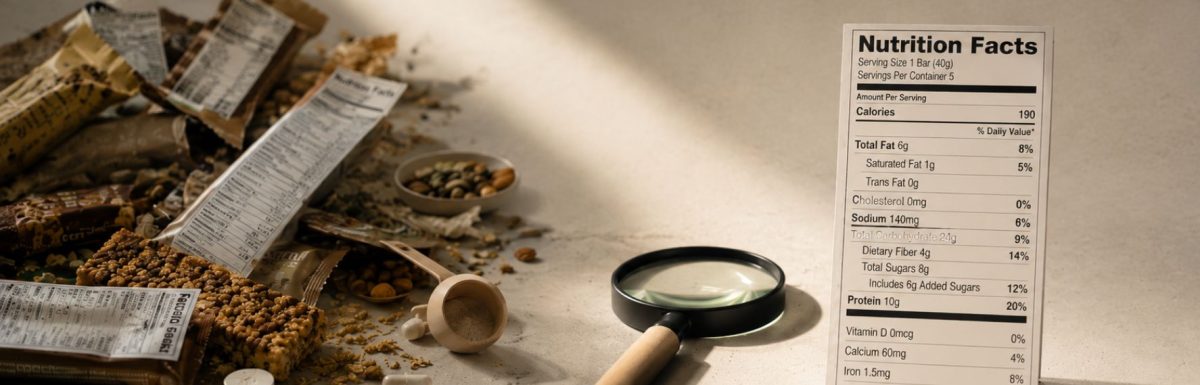
Start with serving size (always)
This is the single most important line on any label, and it is also where most people get quietly misled.
Every number you see on that label, including calories, sugar, fat, sodium, and vitamins, is based on one serving. Not the whole package. Just one serving.
If a bag of crackers lists 140 calories per serving but there are three servings in the bag, and you ate the whole bag, that is 420 calories. The label was not wrong. You just did not do the math.
Before you read anything else, check:
- How much is one serving?
- How many servings are in the package?
- How much of this do I actually eat at once?
This one habit will change how you read labels forever.
Calories: useful, but not the whole story
Calories tell you how much energy is in a serving. That is worth knowing. But they do not tell you whether that energy is coming from something nourishing or something your body will struggle to process.
What matters more is where the calories are coming from:
- Fat (and what kind)
- Carbohydrates (including how much is added sugar vs. fiber)
- Protein
A snack with 200 calories from whole food ingredients is a very different thing from 200 calories from refined flour and corn syrup. Look past the number.
Percent Daily Value: your quick-glance guide
The Percent Daily Value (%DV) shows you how much a single serving contributes toward a standard daily intake. Here is the simple version:
- 5% or less = low in that nutrient
- 20% or more = high in that nutrient
You want high %DV for things like fiber, vitamins, and minerals. You want low %DV for things like saturated fat and sodium.
This is not a perfect system, because individual needs vary, but it is a fast and useful way to compare two products at a glance.
Read the ingredient list from top to bottom
Ingredients are listed by weight, with the most abundant ingredient listed first. That means if sugar is the third ingredient on a “health” bar, there is more sugar in it than almost anything else.
A general rule worth keeping: a shorter ingredient list with recognizable items tends to mean less processing. If the list runs long and full of chemical names you cannot pronounce, take that as information.
You do not have to know every ingredient by heart. Just ask yourself: does this list look like food?
Don’t trust the front of the package
Words like “fortified,” “heart healthy,” “natural,” “gluten-free,” and even “organic” are marketing terms before they are facts. Some of them have regulatory definitions (more on that below). Some of them are essentially meaningless.
The front of the package is designed to get you to pick it up.
The back is where the actual information lives.
What “gluten-free” and “organic” actually mean
Gluten-free doesn’t mean zero gluten
This is an important one if you or someone you care for has celiac disease or significant gluten sensitivity.
A product can be labeled gluten-free if it contains less than 20 parts per million of gluten. That meets the regulatory threshold, but it does not mean the product contains no gluten whatsoever.
There can also be variation in testing, and hidden gluten can show up in additives, flavorings, and sauces even in products with that label on the front. If gluten is a serious health concern for you, read carefully and, when in doubt, check with your healthcare provider.
Organic labels aren’t all equal
Not all organic wording means the same thing. Here’s how it actually breaks down:
- 100% Organic: all ingredients and processing aids are certified organic
- Organic: at least 95% organic ingredients
- Made with Organic: at least 70% organic content
Products labeled “100% organic” and “organic” can carry the USDA organic seal. Products labeled “made with organic” cannot display that seal, though they may list a certifying agent somewhere on the packaging.
If the highest organic standard matters to you, look specifically for “100% organic.”
Decoding produce stickers
Fresh produce often includes a small PLU sticker with a four or five-digit code. Those numbers can tell you more than you might expect:
- A five-digit code starting with 9 generally indicates organically grown produce
- A five-digit code starting with 3 or 4 generally indicates conventionally grown produce
- A five-digit code starting with 8 was intended to indicate GMO produce, though this system isn’t widely used anymore.
How supplement labels work differently from food labels
Food labels and supplement labels are not the same format, and they aren’t regulated the same way either.

Nutrition Facts panels on food focus on calories, macronutrients, vitamins, and minerals in terms of what they contribute to your daily intake.
Supplement Facts panels focus on active ingredients and the specific amounts provided per serving.
The bigger difference is regulatory. Supplements are less strictly regulated than foods and aren’t pre-approved in the same way before they reach store shelves. That is not a reason to avoid supplements. It’s a reason to read their labels more carefully.
Serving size on supplements
On a supplement label, serving size tells you how many capsules, tablets, or scoops equal one serving. Servings per container tells you how long the product will last you.
These two numbers together answer some very practical questions:
- How much of the active ingredient am I actually getting?
- How many capsules do I need to take per dose?
- How many days will this bottle last?
Two products that look comparable at a glance can be very different once you do the math. One product might require three capsules to deliver what another delivers in one.
Active ingredients vs. other ingredients
The main panel on a Supplement Facts label lists active ingredients. Below that, usually in smaller print, is an “other ingredients” section. This is the part most people skip, but it’s worth your time to read it.
Other ingredients can include:
- Fillers and binders
- Capsule materials
- Coatings
- Artificial colors or flavors
- Sweeteners
- Preservatives
A shorter, cleaner “other ingredients” section is generally easier to evaluate. Vague terms like “natural flavors” can cover a wide range of processed flavor compounds, so they’re worth noting even if they’re not always a dealbreaker.
Understanding proprietary blends
A proprietary blend groups several ingredients together and lists a single total amount rather than disclosing how much of each ingredient is included. Companies use them to protect formulas from competitors, and that’s a legitimate reason.
The downside is that it limits transparency. A blend might list impressive-sounding ingredients, but if the individual amounts aren’t disclosed, you have no way to know whether each ingredient is present in a meaningful dose or just a trace.
Proprietary blends are not automatically bad. But transparency builds trust, and a product willing to show you exactly what is in it and how much is usually worth noticing.
Ingredient presence is not the same as an effective dose
This is one of the most useful things to understand about supplement labels.
Seeing an ingredient on a label doesn’t mean it is present in a useful amount. An ingredient might need a much higher dose to do what the marketing suggests. The fact that it’s listed tells you it is there. It doesn’t tell you it is there in enough quantity to matter.
When comparing supplements, ask:
- How much of this ingredient is included?
- Is the amount clearly disclosed?
- Is the product transparent about what that amount is intended to do?
Third-party testing and quality certifications
Because supplements are less strictly regulated than food, quality certifications matter. Here are the ones worth looking for:
- GMP (Good Manufacturing Practices): indicates the product was made according to established manufacturing standards
- Third-party tested: means an independent organization verified the contents, purity, or potency
- Organic: same standards as food labels apply
- Non-GMO: indicates ingredients have not been genetically modified
These seals don’t guarantee a product is right for you, but they do add a layer of independent verification that raw label claims alone cannot provide.
A special note on enzyme supplement labels
If you take digestive enzyme supplements, or are considering them, the label works a little differently and deserves extra attention.
Digestive enzymes help break food down into smaller, absorbable components. Common examples include amylase for carbohydrates, proteases for proteins, lipase for fats, and lactase for lactose.
Activity matters more than milligrams
Here is the most important thing to know about enzyme supplements: milligrams are not the most meaningful measure.
Enzymes are most accurately measured by their activity, meaning how much work they can actually do, not just how much material is in the capsule. A product with fewer milligrams but higher activity units can be significantly more effective than one with a larger-looking number on the label.
When you see these abbreviations on an enzyme label, they are measuring activity:
- HUT (certain protease activity)
- DU (amylase activity)
- FIP (lipase activity)
- CU (cellulase activity)
- GALU (alpha-galactosidase activity)
You don’t need to memorize those units. You just need to look for them. If an enzyme product only lists milligrams with no activity units, that’s a transparency gap worth noting.
Broad-spectrum formulas vs. single enzymes
For general digestive support, a broad-spectrum formula that addresses multiple food types (proteins, carbohydrates, fats, fiber, lactose, and certain grain or legume components) is often more practical than a single-enzyme product.
Also worth checking: whether the formula includes enzymes that can function across a range of pH levels. Broader pH range coverage means the formula can stay active through more of the digestive process, not just one section of the tract.
Sources of supplemental enzymes
Enzyme supplements come from three main sources: animal-derived, plant-derived, and microbial or fungal-derived (often from Aspergillus species). Examples of plant-derived enzymes include bromelain from pineapple and papain from papaya.
Microbial and plant-based enzymes are often preferred in quality formulas because they can remain active in the stomach’s more acidic environment without requiring an enteric coating to survive digestion.
A word on getting to the root
Reading labels more carefully is a meaningful step. And it’s worth saying that even the cleanest, most bioavailable supplement works within a body that is doing the absorbing.
If your digestion has been sluggish, your energy has been inconsistent, or your body seems to respond unpredictably to supplements that should be working, that’s often a signal worth paying attention to at a deeper level. Energy medicine and frequency work address the patterns that can interfere with how the body absorbs, processes, and uses what you give it. Better inputs matter. So does addressing what is underneath.
Common label-reading mistakes (and how to avoid them)
- Ignoring serving size and assuming the label applies to the whole package
- Trusting front-of-package claims without reading the facts panel
- Confusing ingredient presence with effective dose
- Skipping the “other ingredients” section on supplements
- Assuming gluten-free means absolutely no gluten
- Treating all organic claims as equal
- Comparing enzyme supplements by milligrams alone without checking activity units
A simple checklist for how to read nutritional labels on any product
Use this whether you are looking at a food label or a Supplement Facts panel:
- What is the serving size?
- How many servings are in the container?
- For food: what are the calories, and where are they coming from?
- For supplements: what are the active ingredients, and are the amounts clearly disclosed?
- What does the ingredient list look like from top to bottom?
- What is in the “other ingredients” section?
- Are there any vague terms, proprietary blends, or unexplained additives?
- Are there any quality certifications (GMP, third-party tested, etc.)?
- For enzymes: are activity units listed, not just milligrams?
- Does the overall product match what the front label is claiming?
Practical shopping guidance
For packaged foods, look for:
- Shorter ingredient lists with recognizable items
- Fewer artificial additives
- Clear, specific serving sizes
- Transparent labeling (what you see on the back matches what the front says)
For supplements, look for:
- Clearly disclosed amounts for each active ingredient
- A minimal and legible “other ingredients” section
- Relevant certifications
- Transparent dosing (especially for enzymes: activity units, not just weight)
When you’re ready to explore high-quality supplements with clean formulations and clear labeling, Transformation Enzymes are selected with exactly these standards in mind.
If you decide to give it a try, use my coupon code VITALITYPATH at checkout. It takes 20% off your order, and it lets them know you came from here.
Frequently asked questions
How do you read nutritional labels? Start with the serving size, since every other number on the label is based on that amount. Then check calories and where they are coming from (fat, carbohydrates, protein). Use Percent Daily Value as a quick guide: 5% or less is low, 20% or more is high. Read the ingredient list from top to bottom, since ingredients are listed by weight. And always look past the front-of-package marketing to the facts panel on the back.
Why does serving size matter so much? Because every number on the label is based on that serving. If you eat two or three servings, everything multiplies accordingly. Serving size is the lens through which every other number gets interpreted.
Does gluten-free mean a product has no gluten at all? Not necessarily. A product can carry that label if it contains less than 20 parts per million of gluten. For people with celiac disease or significant sensitivity, even that small amount may be relevant.
What is the difference between Nutrition Facts and Supplement Facts? Nutrition Facts are used on food and focus on calories and nutrients relative to daily intake. Supplement Facts are used on supplements and focus on active ingredients and their specific amounts. They are also regulated differently, which is why careful label reading matters more with supplements.
What should I look for in the “other ingredients” section? Fillers, binders, coatings, artificial colors or flavors, sweeteners, and anything listed vaguely. In general, shorter and clearer is easier to evaluate and easier to trust.
Are proprietary blends always a red flag? Not automatically, but they do reduce transparency. When individual ingredient amounts are not disclosed, it is harder to judge whether the doses are meaningful. Transparency is worth rewarding when you find it.
How do I know if an enzyme supplement is actually potent? Check for activity units on the label, not just milligrams. Activity units tell you how much work the enzyme can do. Milligrams only tell you how much material is present.
How do I know which digestive enzyme supplement to use? It depends on where you are starting from. If your digestion is generally okay but you want broader, more comprehensive support, Digest is the workhorse formula. One capsule with each meal delivers a wide range of enzymes covering proteins, fats, carbohydrates, fiber, and more, including lactase for dairy and alpha-galactosidase for beans and legumes.
If your system is more sensitive, or you are newer to digestive enzymes, DigestZyme is the gentler starting point. It combines a core enzyme blend with two probiotics (Lactobacillus acidophilus and Bifidobacterium longum) for added digestive comfort, and it is well tolerated by children and during pregnancy and lactation. Two tiny capsules per meal rather than one normal-sized one. (Be sure to use my coupon code – VITALITYPATH – for a 20% discount)
A simple way to think about it: Digest is for thorough, full-spectrum support. DigestZyme is for sensitive or newer systems that need a gentler introduction, with the added benefit of probiotic support built in. Both are from Transformation Enzymes and are available through The Vitality Path.
What quality seals are worth looking for on supplements? GMP (Good Manufacturing Practices), third-party tested, organic, and non-GMO are the most commonly meaningful markers. They indicate the product was manufactured and verified according to recognized standards.
The Vitality Path supports midlife women in rebuilding from the inside out, using energy medicine, frequency therapy, TCM-based approaches, Human Design, and high-quality supplementation. If you are curious about which supplements might support your specific needs, or about addressing root-cause patterns through energy and frequency work, schedule a free Clarity Call.